


The Domain Name System (DNS) is a hierarchical distributed naming system for computers, services, or any resource connected to the Internet or a private network. It associates various information with domain names assigned to each of the participating entities. Most importantly, it translates domain names meaningful to humans
into the numerical identifiers associated with networking equipment for
the purpose of locating and addressing these devices worldwide.
An often-used analogy to explain the Domain Name System is that it serves as the phone book for the Internet by translating human-friendly computer hostnames into IP addresses. For example, the domain name www.example.com translates to the addresses 192.0.32.10 (IPv4) and 2620:0:2d0:200::10 (IPv6).
The Domain Name System makes it possible to assign domain names
to groups of Internet resources and users in a meaningful way,
independent of each entity's physical location. Because of this, World Wide Web (WWW) hyperlinks
and Internet contact information can remain consistent and constant
even if the current Internet routing arrangements change or the
participant uses a mobile device. Internet domain names are easier to
remember than IP addresses such as 208.77.188.166 (IPv4) or 2001:db8:1f70::999:de8:7648:6e8 (IPv6). Users take advantage of this when they recite meaningful Uniform Resource Locators (URLs) and e-mail addresses without having to know how the computer actually locates them.
The Domain Name System distributes the responsibility of assigning
domain names and mapping those names to IP addresses by designating authoritative name servers
for each domain. Authoritative name servers are assigned to be
responsible for their particular domains, and in turn can assign other
authoritative name servers for their sub-domains. This mechanism has
made the DNS distributed and fault tolerant and has helped avoid the
need for a single central register to be continually consulted and
updated.
In general, the Domain Name System also stores other types of information, such as the list of mail servers that accept email for a given Internet domain. By providing a worldwide, distributed keyword-based redirection service, the Domain Name System is an essential component of the functionality of the Internet.
Other identifiers such as RFID tags, UPCs, international characters in email addresses and host names, and a variety of other identifiers could all potentially use DNS.
The Domain Name System also specifies the technical functionality of
this database service. It defines the DNS protocol, a detailed
specification of the data structures and communication exchanges used in
DNS, as part of the Internet Protocol Suite.
Wednesday, December 28, 2011


Friday, December 23, 2011
Proxy Server
In computer networks, a proxy server is
a server (a computer system or an
application) that acts as an intermediary for requests from clients seeking resources from other servers. A client
connects to the proxy server, requesting some service, such as a file,
connection, web page, or other resource available from a different
server. The proxy server evaluates the request according to its
filtering rules. For example, it may filter traffic by IP
address or protocol. If the
request is validated by the filter, the proxy provides the resource by
connecting to the relevant server and requesting the service on behalf
of the client. A proxy server may optionally alter the client's request
or the server's response, and sometimes it may serve the request without
contacting the specified server. In this case, it 'caches'
responses from the remote server, and returns subsequent requests for
the same content directly.
The proxy concept was invented in the early days of distributed systems as a way to simplify and control their complexity. Today, most proxies are a web proxy, allowing access to content on the World Wide Web.
A proxy server can be placed in the user's local computer or at various points between the user and the destination servers on the Internet.
A reverse proxy is (usually) an Internet-facing proxy used as a front-end to control and protect access to a server on a private network, commonly also performing tasks such as load-balancing, authentication, decryption or caching.
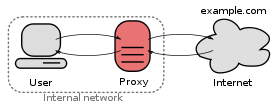
 A forward proxy taking requests from an internal network and forwarding
them to the Internet.
Forward proxies are proxies where the client server names the target
server to connect to.
Forward proxies are able to retrieve from a wide range of sources (in
most cases anywhere on the Internet).
A forward proxy taking requests from an internal network and forwarding
them to the Internet.
Forward proxies are proxies where the client server names the target
server to connect to.
Forward proxies are able to retrieve from a wide range of sources (in
most cases anywhere on the Internet).
The terms "forward proxy" and "forwarding proxy" are a general description of behavior (forwarding traffic) and thus ambiguous. Except for Reverse proxy, the types of proxies described in this article are more specialized sub-types of the general forward proxy concept.
 An open proxy forwarding requests from and to anywhere on the Internet.
The proxy concept was invented in the early days of distributed systems as a way to simplify and control their complexity. Today, most proxies are a web proxy, allowing access to content on the World Wide Web.
Uses
A proxy server has a large variety of potential purposes, including:- To keep machines behind it anonymous, mainly for security.
- To speed up access to resources (using caching). Web proxies are commonly used to cache web pages from a web server.
- To apply access policy to network services or content, e.g. to block undesired sites.
- To access sites prohibited or filtered by your ISP or institution.
- To log / audit usage, i.e. to provide company employee Internet usage reporting.
- To bypass security / parental controls.
- To circumvent Internet filtering to access content otherwise blocked by governments.
- To scan transmitted content for malware before delivery.
- To scan outbound content, e.g., for data loss prevention.
- To allow a web site to make web requests to externally hosted resources (e.g. images, music files, etc.) when cross-domain restrictions prohibit the web site from linking directly to the outside domains.
A proxy server can be placed in the user's local computer or at various points between the user and the destination servers on the Internet.
A reverse proxy is (usually) an Internet-facing proxy used as a front-end to control and protect access to a server on a private network, commonly also performing tasks such as load-balancing, authentication, decryption or caching.
Types of proxy
Forward proxies

The terms "forward proxy" and "forwarding proxy" are a general description of behavior (forwarding traffic) and thus ambiguous. Except for Reverse proxy, the types of proxies described in this article are more specialized sub-types of the general forward proxy concept.
Open proxies

Main article: Open
proxy
An open proxy is a forwarding proxy server that is accessible by any
Internet user. Gordon Lyon estimates there are "hundreds of
thousands" of open proxies on the Internet.
An anonymous open proxy allows users to conceal their IP
address while browsing the Web or using other Internet services.
There are varying degrees of anonymity however, as well as a number of
methods of 'tricking' the client into revealing itself regardless of the
proxy being used.Internet Protocol Address
An Internet Protocol address (IP address) is a
numerical label assigned to each device (e.g., computer, printer)
participating in a computer network that uses the Internet Protocol for communication.
An IP address serves two principal functions: host or network interface
identification and location addressing. Its role has been characterized as follows: "A
name
indicates what we seek. An address indicates where it is. A route
indicates how to get there."
The designers of the Internet Protocol defined an IP address as a 32-bit number and this system, known as Internet Protocol Version 4 (IPv4), is still in use today. However, due to the enormous growth of the Internet and the predicted depletion of available addresses, a new addressing system (IPv6), using 128 bits for the address, was developed in 1995,standardized as RFC 2460 in 1998, and is being deployed worldwide since the mid-2000s.
IP addresses are binary numbers, but they are usually stored in text files and displayed in human-readable notations, such as 172.16.254.1 (for IPv4), and 2001:db8:0:1234:0:567:8:1 (for IPv6).
The Internet Assigned Numbers Authority (IANA) manages the IP address space allocations globally and delegates five regional Internet registries (RIRs) to allocate IP address blocks to local Internet registries (Internet service providers) and other entities.
The designers of the Internet Protocol defined an IP address as a 32-bit number and this system, known as Internet Protocol Version 4 (IPv4), is still in use today. However, due to the enormous growth of the Internet and the predicted depletion of available addresses, a new addressing system (IPv6), using 128 bits for the address, was developed in 1995,standardized as RFC 2460 in 1998, and is being deployed worldwide since the mid-2000s.
IP addresses are binary numbers, but they are usually stored in text files and displayed in human-readable notations, such as 172.16.254.1 (for IPv4), and 2001:db8:0:1234:0:567:8:1 (for IPv6).
The Internet Assigned Numbers Authority (IANA) manages the IP address space allocations globally and delegates five regional Internet registries (RIRs) to allocate IP address blocks to local Internet registries (Internet service providers) and other entities.
IP versions
Two versions of the Internet Protocol (IP) are in use: IP Version 4 and IP Version 6. Each version defines an IP address differently. Because of its prevalence, the generic term IP address typically still refers to the addresses defined by IPv4. The gap in version sequence between IPv4 and IPv6 resulted from the assignment of number 5 to the experimental Internet Stream Protocol in 1979, which however was never referred to as IPv5.Friday, December 16, 2011
Video Graphics Array (VGA)
Video Graphics Array (VGA) refers specifically to the
display hardware first introduced with the IBM PS/2 line of computers in 1987,
but through its widespread adoption has also come to mean either an analog computer display standard, the
15-pin D-subminiature VGA
connector or the 640×480 resolution itself. While this resolution
was superseded in the personal computer market in the 1990s, it is becoming a
popular resolution on mobile devices.
VGA was the last graphical standard introduced by IBM that the majority of PC clone manufacturers conformed to, making it today (as of 2010[update]) the lowest common denominator that all PC graphics hardware can be expected to implement without device-specific driver software.[citation needed] For example, the Microsoft Windows splash screen appears while the machine is still operating in VGA mode, which is the reason that this screen always appears in reduced resolution and color depth.
VGA was officially followed by IBM's Extended Graphics Array (XGA) standard, but it was effectively superseded by numerous slightly different extensions to VGA made by clone manufacturers that came to be known collectively as Super VGA.

VGA compared to other standard resolutions.

A VGA connector.
VGA is referred to as an "array" instead of an "adapter" because it
was implemented from the start as a single chip (an ASIC), replacing the Motorola
6845 and dozens of discrete logic chips that covered the
full-length ISA boards of the MDA, CGA, and EGA. Its single-chip
implementation also allowed the VGA to be placed directly on a PC′s motherboard with a minimum of difficulty (it
only required video memory, timing crystals and an external RAMDAC),
and the first IBM PS/2 models were equipped with VGA on the
motherboard. (Contrast this with all of the "family one" IBM PC desktop
models—the PC, PC/XT, and PC AT—which required a
display adapter installed in a slot in order to connect a monitor.)
The VGA supports both All Points Addressable graphics modes, and alphanumeric text modes. Standard graphics modes are:
The VGA specifications are as follows:
(Total horizontal sync time 6.60 µs)
VGA was the last graphical standard introduced by IBM that the majority of PC clone manufacturers conformed to, making it today (as of 2010[update]) the lowest common denominator that all PC graphics hardware can be expected to implement without device-specific driver software.[citation needed] For example, the Microsoft Windows splash screen appears while the machine is still operating in VGA mode, which is the reason that this screen always appears in reduced resolution and color depth.
VGA was officially followed by IBM's Extended Graphics Array (XGA) standard, but it was effectively superseded by numerous slightly different extensions to VGA made by clone manufacturers that came to be known collectively as Super VGA.
Technical details
Hardware


The VGA supports both All Points Addressable graphics modes, and alphanumeric text modes. Standard graphics modes are:
The VGA specifications are as follows:
- 256 KB Video RAM (The very first cards could be ordered with 64 KB or 128 KB of RAM at the cost of losing some video modes.)
- 16-color and 256-color modes
- 262,144-value color palette (six bits each for red, green, and blue)
- Selectable 25.175 MHz or 28.322 MHz master clock
- Maximum of 800 horizontal pixels
- Maximum of 600 lines
- Refresh rates at up to 70 Hz
- Vertical blank interrupt (Not all clone cards support this.)
- Planar mode: up to 16 colors (4-bit planes)
- Packed-pixel mode: 256 colors (Mode 13h)
- Hardware smooth scrolling support
- Some "Raster Ops" support
- Barrel shifter
- Split screen support
- 0.7 V peak-to-peak
- 75 ohm double-terminated impedance (18.7 mA – 13 mW)
Signal
See also: VGA
connector
The intended value for the horizontal frequency of VGA is exactly
double the value used in the NTSC-M video system. The formula for the VGA
horizontal frequency is thus (60 ÷ 1001) × 525 kHz = 4500 ÷ 143 kHz ≈
31.4686 kHz. All other frequencies used by the VGA card are derived from
this value by integer multiplication or division. Since the exactness
of quartz oscillators is limited, real cards will have slightly higher
or lower frequency. For most common VGA mode 640×480 "60 Hz" non-interlaced the horizontal timings are:| Parameter | Value | Unit |
|---|---|---|
| Pixel clock frequency | 25.175 | MHz |
| Horizontal frequency | 31.4686 | kHz |
| Horizontal pixels | 640 | |
| Horizontal sync polarity | Negative | |
| Total time for each line | 31.77 | µs |
| Front porch (A) | 0.94 | µs |
| Sync pulse length (B) | 3.77 | µs |
| Back porch (C) | 1.89 | µs |
| Active video (D) | 25.17 | µs |
Thursday, December 15, 2011
IBM Corporation
International Business Machines Corporation (NYSE: IBM) or IBM is a multinational technology and consulting corporation headquartered in Armonk, New York, United States. IBM manufactures and sells computer hardware and software, and it offers infrastructure, hosting and consulting services in areas ranging from mainframe computers to nanotechnology. As of September 2011, IBM is the second-largest publicly traded technology company in the world by market capitalization.
The company was founded in 1911 as the Computing Tabulating Recording Corporation through a merger of three companies: the Tabulating Machine Company, the International Time Recording Company, and the Computing Scale Corporation. CTR adopted the name International Business Machines in 1924, using a name previously designated to CTR's subsidiary in Canada and later South America. Its distinctive culture and product branding has given it the nickname Big Blue.
In 2011, Fortune ranked IBM the 18th largest firm in the U.S., as well as the 7th most profitable. Globally, the company was ranked the 31st largest firm by Forbes for 2011. Other rankings for 2011 include #1 company for leaders (Fortune), #2 best global brand (Interbrand), #1 green company worldwide (Newsweek), #12 most admired company (Fortune), and #18 most innovative company (Fast Company). IBM employs more than 425,000 employees (sometimes referred to as "IBMers") in over 200 countries, with occupations including scientists, engineers, consultants, and sales professionals.
IBM holds more patents than any other U.S.-based technology company, and has nine research laboratories worldwide. Its employees have garnered five Nobel Prizes, four Turing Awards, nine National Medals of Technology, and five National Medals of Science.[13] Famous inventions by IBM include the automated teller machine (ATM), the floppy disk, the hard disk drive, the magnetic stripe card, the relational database, the Universal Product Code (UPC), the financial swap, SABRE airline reservation system, DRAM, and Watson artificial intelligence.
The company has undergone several organizational changes since its inception, acquiring companies like SPSS (2009) and PwC consulting (2002), spinning off companies like Lexmark (1991), and selling off product lines like ThinkPad to Lenovo (2005).
Sam Palmisano will step down as CEO as of January 1, 2012, but retain his position as chairman. He will be replaced by veteran IBMer Ginni Rometty.
The company was founded in 1911 as the Computing Tabulating Recording Corporation through a merger of three companies: the Tabulating Machine Company, the International Time Recording Company, and the Computing Scale Corporation. CTR adopted the name International Business Machines in 1924, using a name previously designated to CTR's subsidiary in Canada and later South America. Its distinctive culture and product branding has given it the nickname Big Blue.
In 2011, Fortune ranked IBM the 18th largest firm in the U.S., as well as the 7th most profitable. Globally, the company was ranked the 31st largest firm by Forbes for 2011. Other rankings for 2011 include #1 company for leaders (Fortune), #2 best global brand (Interbrand), #1 green company worldwide (Newsweek), #12 most admired company (Fortune), and #18 most innovative company (Fast Company). IBM employs more than 425,000 employees (sometimes referred to as "IBMers") in over 200 countries, with occupations including scientists, engineers, consultants, and sales professionals.
IBM holds more patents than any other U.S.-based technology company, and has nine research laboratories worldwide. Its employees have garnered five Nobel Prizes, four Turing Awards, nine National Medals of Technology, and five National Medals of Science.[13] Famous inventions by IBM include the automated teller machine (ATM), the floppy disk, the hard disk drive, the magnetic stripe card, the relational database, the Universal Product Code (UPC), the financial swap, SABRE airline reservation system, DRAM, and Watson artificial intelligence.
The company has undergone several organizational changes since its inception, acquiring companies like SPSS (2009) and PwC consulting (2002), spinning off companies like Lexmark (1991), and selling off product lines like ThinkPad to Lenovo (2005).
Sam Palmisano will step down as CEO as of January 1, 2012, but retain his position as chairman. He will be replaced by veteran IBMer Ginni Rometty.
AMD Processor
Advanced Micro Devices
From Wikipedia, the free encyclopedia
"AMD" redirects here. For other uses, see AMD (disambiguation).
 |
|
| Type | Public company S&P 500 Component |
|---|---|
| Traded as | NYSE: AMD |
| Industry | Semiconductors |
| Founded | 1969 |
| Founder(s) | Jerry Sanders Edwin Turney Additional co-founders |
| Headquarters | One AMD Place, Sunnyvale, California, U.S. |
| Area served | Worldwide |
| Key people | Bruce Claflin (Executive Chairman) Rory Read (CEO) |
| Products | Microprocessors Motherboard chipsets Graphics processors |
| Revenue |  US$ 6.494 billion (2010) US$ 6.494 billion (2010) |
| Operating income | US$ 824 million (2010) |
| Net income | US$ 471 million (2010) |
| Total assets |  US$ 4.964 billion (2010) US$ 4.964 billion (2010) |
| Total equity | US$ 1.013 billion (2010) |
| Employees | 11,100 (2010) |
| Website | AMD.com |
AMD is the second-largest global supplier of microprocessors based on the x86 architecture and also one of the largest suppliers of graphics processing units. It also owns 8.6% of Spansion, a supplier of non-volatile flash memory.[2]
AMD is the only significant rival to Intel in the central processor (CPU) market for (x86 based) personal computers. Together they held 99.1 percent (Intel 80.3%, AMD 18.8%) of the CPU's sold for quarter three of 2011. AMD and competitor Nvidia dominate the graphics processor (GPU) market, covering all of the top 70% of the performance benchmark, and making up 78 percent (Nvidia 44.8%, AMD 33.2%) of the GPUs in use in (x86 based) personal computers (Intel holding 6.6%).
Corporate history


During this time, AMD attempted to embrace the perceived shift towards RISC with their own AMD 29K processor, and also attempted to diversify into graphics and audio devices as well as EPROM memory. It had some success in the mid-1980s with the AMD7910 and AMD7911 "World Chip" FSK modem, one of the first multistandard devices that covered both Bell and CCITT tones at up to 1200 baud half duplex or 300/300 full duplex. The AMD 29K survived as an embedded processor and AMD spinoff Spansion continues to make industry leading flash memory. AMD decided to switch gears and concentrate solely on Intel-compatible microprocessors and flash memory, placing them in direct competition with Intel for x86 compatible processors and their flash memory secondary markets.
AMD announced the acquisition of ATI Technologies on July 24, 2006. AMD paid $4.3 billion in cash and 58 million shares of its stock for a total of US$5.4 billion. The transaction completed on October 25, 2006.
It was reported in December 2006 that AMD, along with its main rival in the graphics industry Nvidia, received subpoenas from the Justice Department regarding possible antitrust violations in the graphics card industry, including the act of fixing prices.
In October 2008, AMD announced plans to spin off manufacturing operations in the form of a multibillion-dollar joint venture with Advanced Technology Investment Co., an investment company formed by the government of Abu Dhabi. The new venture is called GlobalFoundries Inc.. This partnership will allow AMD to focus solely on chip design.
In August 2011, AMD announced that former Lenovo executive Rory Read would be joining the company as CEO.
On November 3, 2011 AMD said it was going to lay off 1,400 employees or about 10 percent of current worldwide staff. The curtailment will be finalized at Q1 2012 and mainly before Christmas 2011. It will cut operational saving by $10 million in Q4 2011 and more than $200 million in 2012.
All Intel Core
Intel Core is a brand name used for various mid-range to high-end consumer and business microprocessors made by Intel.
In general, processors sold as Core are more powerful variants of the same processors marketed as entry-level Celeron and Pentium. Similarly, identical or more capable versions of Core processors are also sold as Xeon processors for the server market.
The current lineup of Core processors includes the latest Intel Core i7, Intel Core i5 and Intel Core i3, and the older Intel Core 2 Solo, Intel Core 2 Duo, Intel Core 2 Quad, and Intel Core 2 Extreme lines.[1]
In general, processors sold as Core are more powerful variants of the same processors marketed as entry-level Celeron and Pentium. Similarly, identical or more capable versions of Core processors are also sold as Xeon processors for the server market.
The current lineup of Core processors includes the latest Intel Core i7, Intel Core i5 and Intel Core i3, and the older Intel Core 2 Solo, Intel Core 2 Duo, Intel Core 2 Quad, and Intel Core 2 Extreme lines.[1]
Overview
| Brand | Desktop | Laptop | ||||||
|---|---|---|---|---|---|---|---|---|
| Code-named | Cores | Fab | Date released | Code-named | Cores | Fab | Date released | |
| Core Solo |
|
Yonah | 1 | 65 nm | Jan 2006 | |||
| Core Duo |
|
Yonah | 2 | 65 nm | Jan 2006 | |||
| Core 2 Solo |
|
Merom-L Penryn-L |
1 1 |
65 nm 45 nm |
Sep 2007 May 2008 |
|||
| Core 2 Duo | Conroe Allendale Wolfdale |
2 2 2 |
65 nm 65 nm 45 nm |
Aug 2006 Jan 2007 Jan 2008 |
Merom Penryn |
2 2 |
65 nm 45 nm |
Jul 2006 Jan 2008 |
| Core 2 Quad | Kentsfield Yorkfield |
4 4 |
65 nm 45 nm |
Jan 2007 Mar 2008 |
Penryn | 4 | 45 nm | Aug 2008 |
| Core 2 Extreme | Conroe XE Kentsfield XE Yorkfield XE |
2 4 4 |
65 nm 65 nm 45 nm |
Jul 2006 Nov 2006 Nov 2007 |
Merom XE Penryn XE Penryn XE |
2 2 4 |
65 nm 45 nm 45 nm |
Jul 2007 Jan 2008 Aug 2008 |
| Core i3 | Clarkdale Sandy Bridge |
2 2 |
32 nm 32 nm |
Jan 2010 Feb 2011 |
Arrandale Sandy Bridge |
2 2 |
32 nm 32 nm |
Jan 2010 Feb 2011 |
| Core i5 | Lynnfield Clarkdale Sandy Bridge Sandy Bridge |
4 2 4 2 |
45 nm 32 nm 32 nm 32 nm |
Sep 2009 Jan 2010 Jan 2011 Feb 2011 |
Arrandale Sandy Bridge |
2 2 |
32 nm 32 nm |
Jan 2010 Feb 2011 |
| Core i7 | Bloomfield Lynnfield Gulftown Sandy Bridge |
4 4 6 4 |
45 nm 45 nm 32 nm 32 nm |
Nov 2008 Sep 2009 Jul 2010 Jan 2011 |
Clarksfield Arrandale Sandy Bridge Sandy Bridge |
4 2 4 2 |
45 nm 32 nm 32 nm 32 nm |
Sep 2009 Jan 2010 Jan 2011 Feb 2011 |
| Core i7 Extreme Edition |
Bloomfield Gulftown |
4 6 |
45 nm 32 nm 32 nm |
Nov 2008 March 2010 |
Clarksfield Sandy Bridge |
4 4 |
45 nm 32 nm |
Sep 2009 Jan 2011 |
|
| ||||||||
Intel Core 2 Duo
Core 2 is a brand encompassing a range of Intel's consumer 64-bit x86-64 single-, dual-, and quad-core microprocessors based on the Core microarchitecture. The single- and dual-core models are single-die, whereas the quad-core models comprise two dies, each containing two cores, packaged in a multi-chip module. The introduction of Core 2 relegated the Pentium brand to the mid-range market, and reunified laptop and desktop CPU lines, which previously had been divided into the Pentium 4, Pentium D, and Pentium M brands.
The Core 2 brand was introduced on July 27, 2006, comprising the Solo (single-core), Duo (dual-core), Quad (quad-core), and in 2007, the Extreme (dual- or quad-core CPUs for enthusiasts) subbrands. Intel Core 2 processors with vPro technology (designed for businesses) include the dual-core and quad-core branches.
The Core 2 branded processors feature Virtualization Technology (with some exceptions), Execute Disable Bit, and SSE3. Their Core microarchitecture introduced SSSE3, Trusted Execution Technology, Enhanced SpeedStep, and Active Management Technology (iAMT2). With a maximum thermal design power (TDP) of 65W, the Core 2 Duo Conroe dissipates half the power of the less capable contemporary Pentium D-branded desktop chips that have a max TDP of 130W.
The Core 2 brand was introduced on July 27, 2006, comprising the Solo (single-core), Duo (dual-core), Quad (quad-core), and in 2007, the Extreme (dual- or quad-core CPUs for enthusiasts) subbrands. Intel Core 2 processors with vPro technology (designed for businesses) include the dual-core and quad-core branches.
Models
For Detailed discussion of CPU cores, see Intel Core (microarchitecture)#Processor cores.
The Core 2-branded CPUs include: "Conroe"/"Allendale"
(dual-core for desktops), "Merom" (dual-core for laptops), "Merom-L"
(single-core for laptops), "Kentsfield" (quad-core for desktops), and
the updated variants named "Wolfdale" (dual-core for desktops), "Penryn"
(dual-core for laptops), and "Yorkfield" (quad-core for desktops).
(Note: For the server and workstation "Woodcrest", "Tigerton", "Harpertown" and "Dunnington" CPUs see the Xeon brand.)The Core 2 branded processors feature Virtualization Technology (with some exceptions), Execute Disable Bit, and SSE3. Their Core microarchitecture introduced SSSE3, Trusted Execution Technology, Enhanced SpeedStep, and Active Management Technology (iAMT2). With a maximum thermal design power (TDP) of 65W, the Core 2 Duo Conroe dissipates half the power of the less capable contemporary Pentium D-branded desktop chips that have a max TDP of 130W.
Intel Pentium Dual Core
The Pentium Dual-Core brand was used for mainstream x86-architecture microprocessors from Intel from 2006 to 2009 when it was renamed to Pentium. The processors are based on either the 32-bit Yonah or (with quite different microarchitectures) 64-bit Merom-2M, Allendale, and Wolfdale-3M core, targeted at mobile or desktop computers.
In terms of features, price and performance at a given clock frequency, Pentium Dual-Core processors were positioned above Celeron but below Core and Core 2 microprocessors in Intel's product range. The Pentium Dual-Core was also a very popular choice for overclocking, as it can deliver high performance (when overclocked) at a low price.
Processor cores
In 2006, Intel announced a plan to return the Pentium trademark from retirement to the market, as a moniker of low-cost Core microarchitecture processors based on the single-core Conroe-L but with 1 MiB of cache. The identification numbers for those planned Pentiums were similar to the numbers of the latter Pentium Dual-Core microprocessors, but with the first digit "1", instead of "2", suggesting their single-core functionality. A single-core Conroe-L with 1 MiB cache was deemed as not strong enough to distinguish the planned Pentiums from the Celerons, so it was replaced by dual-core CPUs, adding "Dual-Core" to the line's name. Throughout 2009, Intel changed the name back from Pentium Dual-Core to Pentium in its publications. Some processors were sold under both names, but the newer E5400 through E6800 desktop and SU4100/T4x00 mobile processors were not officially part of the Pentium Dual-Core line.
Subscribe to:
Posts (Atom)

